Test weather

Sunday, June 26, 2011

History of the USAF Thunderbirds Team- Part 1

 F-84 G Thunderjet


F-100 Super Sabre

Thunderbird's Origins 

The Thunderbirds were officially activated May 25, 1953, as the 3600th Air Demonstration Team at Luke Air Force Base, Ariz.The unit's first aircraft was the straight-winged F-84G Thunderjet, a combat-proven fighter-bomber that had seen extensive action in the Korean War. Early in 1955, the Thunderbirds transitioned to the swept-wing F-84F Thunderstreak. In their first three years with the F-84, the team performed for more than nine million spectators in 222 shows that included tours of Central and South America.
In June 1956, the team moved to its current home at Nellis Air Force Base, Nev. At the same time, the Thunderbirds traded the veteran F-84 for the world's first supersonic fighter, the F-100 Super Sabre --the aerial platform that would serve the Thunderbirds for 13 years. The F-100 years were memorable. More than 1,100 demonstrations were flown in the "C" and "D" models of the aircraft, thrilling spectators from the Far East to North Africa. In the middle of the F- 100 era, the team changed briefly to the F-1O5B Thunderchief. After only six shows in 1964, due to an extensive modification that became necessary on all Thunderchiefs, the Thunderbirds transitioned to theF-1OOD, a jet that was capable of air refueling, which allowed the squadron to fly greater distances in less time.


YouTube - Mikael Carlson's Fokker Dr 1 Dreidecker flies!

YouTube - Mikael Carlson's Fokker Dr 1 Dreidecker flies!

Saturday, June 25, 2011

Thunderbird History - Part 4 (Mid 80's -)


Early in 1983, the Thunderbirds reinstituted their traditional role of demonstrating the AirForce's frontline fighter capabilities. Transitioning to the F-16A Fighting Falcon allowed the team to demonstrate the very latest in fighter technology. In 1987, the Thunderbirds became the first U.S.demonstration squadron to perform in a communist country, as the team visited China. In 1991, theteam traveled to Europe for the first time since 1984. During the 30-day tour, 11 air demonstration swere performed in eight countries, including first-time visits to Switzerland, Poland, and Hungary.
In 1992, the Thunderbirds transitioned to the F-16C for their aerial demonstrations. The squadron was the last active-duty unit to convert to the upgraded model. The conversion took place simply because the team represents the rest of the Air Force and every frontline F-16 squadron employs the F-16C. The switch also made sense for logistical and combat-conversion reasons. In its rookie season, the Thunderbirds took their F-16Cs on a 17-day tour of Latin American countries. All totalled, 75 air demonstrations were performed before an estimated 6.6 million people in 1992.
The 40th anniversary air demonstration season was abruptly cut short after a pilot injury. The commander /leader was unable to fly the final 14 scheduled air demonstrations due to a lower back injury. The lead jet position serves as the platform for all the maneuvers performed during an air demonstration and as leader, his style of everything -- from making the majority of radio calls to his steady inputs of airmanship -- is critical to the success of every performance. The squadron still traveled to those canceled airshow sites and delivered poise, professionalism, and public relations inother forms, to include static displays, media orientation flights, autograph signings, and visits to local schools and hospitals. One of the highlights of the season was the 800th air demonstration flown inthe F- 16. More than 8 million people saw the Thunderbirds in 1993.
The 1994 demonstration season proudly ushered in the U.S. Air Force Air Demonstration Squadron's fifth decade. The Thunderbirds flew 67 air demonstrations in front of more than 6 million people, surpassing the 275 million mark for attendance. Traveling to the Far East in August, the squadron's 26-day "Thunder Over the Pacific" tour showed 1.3 million spectators in Alaska, Japan,Korea, Thailand, Singapore, Malaysia, Guam, and Hawaii the capabilities of American airpower.


Thunderbird History - Part 3 (The Mid 70's to Mid 80's)


In 1974, the Thunderbirds converted to the T-38A Talon, the world's first supersonic trainer aircraft. The T-38 was more fuel efficient and less costly to maintain than the larger F-4. The team flew nearly 600 demonstrations during eight seasons with the Talon.


Thunderbird History - Part 2 (The Early 70's)

Thunderbird History - Part 2 (The Early 70's)


The Thunderbirds flew the Air Force's frontline fighter of the time, theF-4E Phantom II.From 1969 to 1973,  In five seasons, the team performed more than 500 demonstrations while traveling to 30 of the 50 states, Canada, Central America, and Europe.


Thunderbird History The Early Days

 F-84 G Thunderjet


F-100 Super Sabre

Thunderbird's Origins 

The Thunderbirds were officially activated May 25, 1953, as the 3600th Air Demonstration Team at Luke Air Force Base, Ariz.The unit's first aircraft was the straight-winged F-84G Thunderjet, a combat-proven fighter-bomber that had seen extensive action in the Korean War. Early in 1955, the Thunderbirds transitioned to the swept-wing F-84F Thunderstreak. In their first three years with the F-84, the team performed for more than nine million spectators in 222 shows that included tours of Central and South America.
In June 1956, the team moved to its current home at Nellis Air Force Base, Nev. At the same time, the Thunderbirds traded the veteran F-84 for the world's first supersonic fighter, the F-100 Super Sabre --the aerial platform that would serve the Thunderbirds for 13 years. The F-100 years were memorable. More than 1,100 demonstrations were flown in the "C" and "D" models of the aircraft, thrilling spectators from the Far East to North Africa. In the middle of the F- 100 era, the team changed briefly to the F-1O5B Thunderchief. After only six shows in 1964, due to an extensive modification that became necessary on all Thunderchiefs, the Thunderbirds transitioned to theF-1OOD, a jet that was capable of air refueling, which allowed the squadron to fly greater distances in less time.


Sunday, June 12, 2011

The Ancient Modeler

Confessions of an Ancient Modeler:-


I’ve been interested in Model Aircraft, for a number of years; approximately 70, if my memory is still accurate. In 1942, when I was 7, the Govt. built an airport and opened a training base for pilots near my town. It was “basic training” and consisted of Tiger Moths, Cornells and Ansons (Mk V). At any time of the day “we” (myself and two friends) could look up and see numerous aircraft in the “circuit” which, depending on the wind, took them over the town. The “WAR” was on and we listened each day to the news and to radio programs like “L for Lanky”(1) which depicted the adventures of a Lancaster Crew on various bombing missions. On a Saturday night, with the lights turned down, we were mesmerized by the drone of the engines and the chatter of the crew, and flew with them to various “targets” in Europe. My Uncle had a pile of lumber that we were allowed to re-arrange and this (with a little imagination and a few cardboard boxes) became all manner of aircraft in which we “flew” countless successful missions.
The closest we got to models in those days were those on the back of cereal boxes.
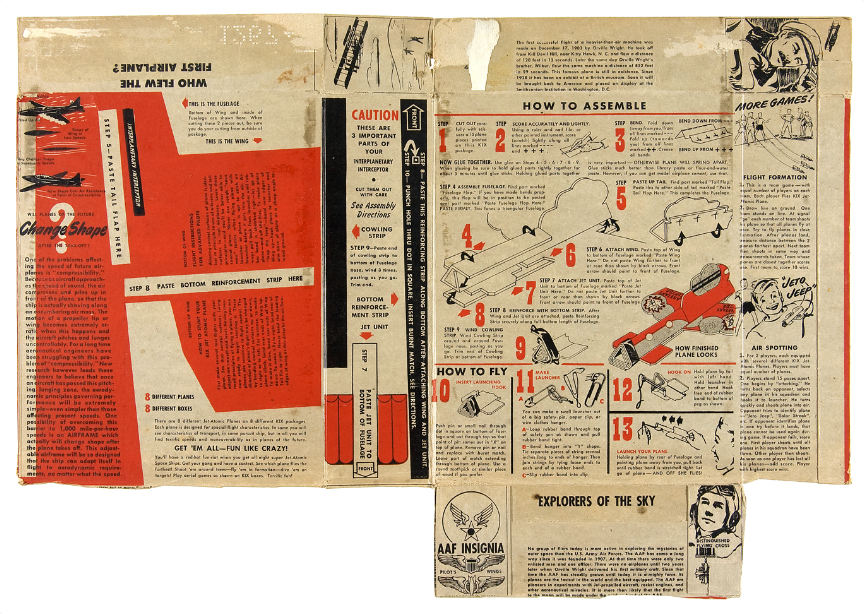
We were constantly on the search for ways to consume more cereal. My cousin was fortunate in that they had a dog that would eat corn flakes. I not being so lucky, had to invent other ways. You may be interested to know that you can get almost twice the amount into a bowl if you let them soak for a few minutes in the milk. This is accomplished by washing your hands (of course) before sitting down and neglecting to turn off the tap, whereupon my father (who I am sure was onto my game) would decree that I was not to have a spoonful until I had attended to said tap. The return trip to the bathroom could take several minutes, and by that time you could replenish the level of cornflakes in the bowl. Shreddies, of course, were a whole different ball game.
By 1948 “we” were into models in a big way. I was 13 with a bicycle and a job delivering parcels for a store, which paid $5 a week. We had persuaded the local drug store to get model magazines, and waited impatiently for each issue of “Flying Models” “Model Airplane News” and “Air Trails”. Initially we built gliders and rubber powered. In those days when someone referred to the “size of a motor” they meant “how many strands of T-56”. Kits consisted of sheets of balsa with the shape of formers etc. stamped onto them. Cutting out these parts was an art in itself and by the time you finished one sheet of ribs etc. you usually had so many “Band-Aids” on your fingers that you could not hold the razor blade (double edged). We eventually developed our own version of the Xacto knife by gluing half of a blade between two Popsicle sticks which were then wrapped with thread. Glue was called "Balsa Cement".
It was a clear cellulose product, and was easy to sand, although about later, Testors came out with Formula A and Formula B and there was mention in the magazines of some new adhesive called “epoxy”. The covering was silkspan, jap tissue, bamboo paper, or silk (if you could afford it), applied with banana oil or dope and shrunk with water.
It took us a while to get on to the water bit, and it happened quite by accident. It was summer, and we were building in my cousin’s garage. The flies were particularly bad, probably because we had been cleaning fish there the day before. There was, back then, a product called “Flytox” which was mixed with water and applied by means of a hand operated sprayer (Flit Gun) to the surrounding area and hopefully said flies. My cousin was not having the best of days and at one point the flies got the better of him. He grabbed the sprayer and filled the air with “Flytox”. When his rage had subsided (he ran out of spray) we discovered that he had literally soaked his latest model which had been sitting innocently at the end of the bench. The plane looked like a starving horse with the silkspan dripping wet. We wiped it off as best we could and decided to wait ‘till next day to see what could be salvaged. I was at his door by 8:00 A.M. and we proceeded to the garage to view the expected disaster. To our astonishment the model had been transformed into a thing of beauty. The covering was “drum tight” and even most of the flies were dead. It was obvious that the spray had tightened the covering, and we used it on a number of successive planes before we discovered that it was actually the water that caused the tissue to shrink.
It was around this time that I mustered enough courage (and money) to send for a “1/2 A Flying Outfit” consisting of a Berkley Puddle Jumper and an Anderson Spitfire .045, with the new Ray Arden "glo-plug,  plus all accessories. The cost was $7.75 U.S. plus shipping and my Mother predicted that I would never receive it.


 After what seemed an eternity of checking the post office each day and much to Mother’s disappointment, the coveted package arrived. The plane was a 19 in. U Control, and the engine (notice I did not say motor) was a thing of beauty. We read and re-read the instructions only to discover that “all accessories” did not include a surprising number of items necessary for operation. The closest source of said items was Ottawa, but it might just as well been the moon. Then the Gods smiled upon us. A new arrival at school heard of our aeronautical endeavors and introduced himself. His father built model boats and not only knew of, but made frequent trips to, Hobby Shops in Ottawa. The son was keen to try model airplanes and assured us that if he were admitted to the “Club”, (we now called ourselves a club) his father could pick up needed supplies on his trips to Ottawa. “Admit him?” hell; we made him President.
Within a matter of days/weeks I had glo fuel (Ohlsson & Rice) and a 1 ½ volt battery along with a 6x3 prop. The “spitfire” was mounted on a piece of wood clamped in a vise, which we had in our basement, and the “break-in” commenced. After many days of flipping the prop, and several batteries, it suddenly roared to life. The smell of burned castor oil, and the sound, oh! that sound. I can still hear it if I close my eyes. It almost drowned out my Mother’s screams as she flew down the basement stairs convinced that the house was on fire. I was oblivious to her commands to “turn that damn thing off” and would have endured the “wrath of God” before doing so: though by now my Mother’s was running a close second. The engine ran out of fuel at about the same time as my Mother ran out of breath and she retreated back up the stairs predicting severe damage to my anatomy when my Father returned. Needless to say all subsequent running took place outside.
ow that we had “mastered” the engine (the plane had been completed) we proceeded to attempt to fly “U- control”. We had achieved limited success with our gliders and rubber powered planes, and the prospect of “hands on control” was fascinating. At first we tried hand launching over tall grass, but this was not as easy as we hoped. Our initial flights were measured in degrees rather than laps, and a complete lap was rarely achieved. It was at this point that someone (I forget who) came up with the idea of taking off from a sheet of “masonite” propped up at one end. This proved to be the answer and we were soon able to stay airborne for the duration of a tank of fuel. By now all four of us had planes and we flew from the school grounds on weekends.
We learned of and joined MAAC, (my # is 592) and by 1953 were building gas powered free flights, and flying from the now abandoned airport . Some of my fondest  recollections are of a plane called a Zenith built from plans and powered by an .099 Cub. On warm summer evenings it would “take off” from the runway climb to about 400 feet and then glide down to land (if I was lucky) on the pavement. We never managed to get to Radio Control. It was well beyond our resources, but we read of it in the magazines and actually got to see one at a contest .
By 1954 it was all over. My three friends and I graduated from High School and went our separate ways. I did not renew my interest in modeling until 1982 when I was preparing for retirement (in 1990).
My Model Aircraft 28 year hiatus spared me from having to suffer through the various stages of RC equipment  development (2). Single channel with rubber powered escapements and electric driven actuators, 4 function reeds, analogue pulse rudder and 3 function galloping ghost, to name just a few.
.

Babcock Single Channel (Circa 1955)
Thought to be relatively reliable for it's time the receiver powered a relay which in turn the escapement 1 pulse right rudder 2 pulses for left
You can imagine my amazement when I purchased a copy of RCM. My first radio was a Royal Classic purchased from Art Large, and my trainer was a Bud Barkley Cessna. I eventually learned to “fly?” with the help and patience of numerous people and progressed (?) from there to the present.


My prime interest is in Scale and I have, of late, ventured into the realm of electrics.
The writing of this epistle has unlocked my memory and brought back numerous incidents in addition to the ones I have shared. The senior modelers among you will understand my nostalgia and, I hope, recall that special day when they finally “got everything right” and  their model actually flew.


(1). 6.iii.L FOR LANKY: The radio drama exploits of a Lancaster bomber
The CBC radio programme, "L for Lanky," was a very imaginative program which many of us remember fondly from our childhoods.  "L for Lanky" means the Lancaster bomber that was the central figure in the show. It was about a WWII flight crew and their adventures going out on raids with this bomber -- but the "narrator" of the program was the Lancaster bomber itself.   The plane was given a voice and a personality, and it began each show setting up the premise, in a slightly echoed voice with airplane sound behind it, and it always started out by saying "I'm L for Lanky.  I'm a Lancaster bomber....."  And on it went from there, setting up that week's story and then the regular actors as airmen  took over. The voice of Lanky was played by an actor named Herb Gott.  A great example of how well radio tapped into the theatre of the mind - one simply bought the premise without question. Otherwise they were standard WW2 air adventures.  Apparently most of the ETs were destroyed after the war and apparently there is little evidence of the show in the CBC archives. There are rumours of excerpts still in existence.
Suggested by Sam Levene and George Coppen
"Air Force Fans also had their own wartime show, a drama " L For Lanky" sponsored by the Canadian Marconi Company, written by Don Bassett, and produced by Alan Savage. Again true war stories were implanted on a fictional bomber "L For Lanky. This show was almost as successful as "Fighting Navy" and included in the cast were Jack Fuller, Jules Upton, George Murray, Herb Gott, Art Martin and Vincent Tovell."
From Coast To Coast, A Personal History Of Radio In Canada by Sandy Stewart

(2) The Golden Age of RC Development

Thursday, June 9, 2011

User's Page 1


Member's Activities:-


Send us your photos, videos, construction projects, or anything you think would be interesting to our visitors and we will post them here.


Confessions of an Ancient Modeler:-


I’ve been interested in Model Aircraft, for a number of years; approximately 70, if my memory is still accurate. In 1942, when I was 7, the Govt. built an airport and opened a training base for pilots near my town. It was “basic training” and consisted of Tiger Moths, Cornells and Ansons (Mk V). At any time of the day “we” (myself and two friends) could look up and see numerous aircraft in the “circuit” which, depending on the wind, took them over the town. The “WAR” was on and we listened each day to the news and to radio programs like “L for Lanky” (1) which depicted the adventures of a Lancaster Crew on various bombing missions. On a Saturday night, with the lights turned down, we were mesmerized by the drone of the engines and the chatter of the crew, and flew with them to various “targets” in Europe. My Uncle had a pile of lumber that we were allowed to re-arrange and this (with a little imagination and a few cardboard boxes) became all manner of aircraft in which we “flew” countless successful missions.
The closest we got to models in those days were those on the back of cereal boxes.
We were constantly on the search for ways to consume more cereal. My cousin was fortunate in that they had a dog that would eat corn flakes. I not being so lucky, had to invent other ways. You may be interested to know that you can get almost twice the amount into a bowl if you let them soak for a few minutes in the milk. This is accomplished by washing your hands (of course) before sitting down and neglecting to turn off the tap, whereupon my father (who I am sure was onto my game) would decree that I was not to have a spoonful until I had attended to said tap. The return trip to the bathroom could take several minutes, and by that time you could replenish the level of cornflakes in the bowl. Shreddies, of course, were a whole different ball game.
By 1948 “we” were into models in a big way. I was 13 with a bicycle and a job delivering parcels for a store, which paid $5 a week. We had persuaded the local drug store to get model magazines, and waited impatiently for each issue of “Flying Models” “Model Airplane News” and “Air Trails”. Initially we built gliders and rubber powered. In those days when someone referred to the “size of a motor” they meant “how many strands of T-56”. Kits consisted of sheets of balsa with the shape of formers etc. stamped onto them. Cutting out these parts was an art in itself and by the time you finished one sheet of ribs etc. you usually had so many “Band-Aids” on your fingers that you could not hold the razor blade (double edged). We eventually developed our own version of the Xacto knife by gluing half of a blade between two Popsicle sticks which were then wrapped with thread. Glue was called "Balsa Cement".
It was a clear cellulose product, and was easy to sand, although about later, Testors came out with Formula A and Formula B and there was mention in the magazines of some new adhesive called “epoxy”. The covering was silkspan, jap tissue, bamboo paper, or silk (if you could afford it), applied with banana oil or dope and shrunk with water.
It took us a while to get on to the water bit, and it happened quite by accident. It was summer, and we were building in my cousin’s garage. The flies were particularly bad, probably because we had been cleaning fish there the day before. There was, back then, a product called “Flytox” which was mixed with water and applied by means of a hand operated sprayer (Flit Gun) to the surrounding area and hopefully said flies. My cousin was not having the best of days and at one point the flies got the better of him. He grabbed the sprayer and filled the air with “Flytox”. When his rage had subsided (he ran out of spray) we discovered that he had literally soaked his latest model which had been sitting innocently at the end of the bench. The plane looked like a starving horse with the silkspan dripping wet. We wiped it off as best we could and decided to wait ‘till next day to see what could be salvaged. I was at his door by 8:00 A.M. and we proceeded to the garage to view the expected disaster. To our astonishment the model had been transformed into a thing of beauty. The covering was “drum tight” and even most of the flies were dead. It was obvious that the spray had tightened the covering, and we used it on a number of successive planes before we discovered that it was actually the water that caused the tissue to shrink.
It was around this time that I mustered enough courage (and money) to send for a “1/2 A Flying Outfit” consisting of a Berkley Puddle Jumper and an Anderson Spitfire .045, with the new Ray Arden "glo-plug,  plus all accessories. The cost was $7.75 U.S. plus shipping and my Mother predicted that I would never receive it.


 After what seemed an eternity of checking the post office each day and much to Mother’s disappointment, the coveted package arrived. The plane was a 19 in. U Control, and the engine (notice I did not say motor) was a thing of beauty. We read and re-read the instructions only to discover that “all accessories” did not include a surprising number of items necessary for operation. The closest source of said items was Ottawa, but it might just as well been the moon. Then the Gods smiled upon us. A new arrival at school heard of our aeronautical endeavors and introduced himself. His father built model boats and not only knew of, but made frequent trips to, Hobby Shops in Ottawa. The son was keen to try model airplanes and assured us that if he were admitted to the “Club”, (we now called ourselves a club) his father could pick up needed supplies on his trips to Ottawa. “Admit him?” hell; we made him President.
Within a matter of days/weeks I had glo fuel (Ohlsson & Rice) and a 1 ½ volt battery along with a 6x3 prop. The “spitfire” was mounted on a piece of wood clamped in a vise, which we had in our basement, and the “break-in” commenced. After many days of flipping the prop, and several batteries, it suddenly roared to life. The smell of burned castor oil, and the sound, oh! that sound. I can still hear it if I close my eyes. It almost drowned out my Mother’s screams as she flew down the basement stairs convinced that the house was on fire. I was oblivious to her commands to “turn that damn thing off” and would have endured the “wrath of God” before doing so: though by now my Mother’s was running a close second. The engine ran out of fuel at about the same time as my Mother ran out of breath and she retreated back up the stairs predicting severe damage to my anatomy when my Father returned. Needless to say all subsequent running took place outside.
ow that we had “mastered” the engine (the plane had been completed) we proceeded to attempt to fly “U- control”. We had achieved limited success with our gliders and rubber powered planes, and the prospect of “hands on control” was fascinating. At first we tried hand launching over tall grass, but this was not as easy as we hoped. Our initial flights were measured in degrees rather than laps, and a complete lap was rarely achieved. It was at this point that someone (I forget who) came up with the idea of taking off from a sheet of “masonite” propped up at one end. This proved to be the answer and we were soon able to stay airborne for the duration of a tank of fuel. By now all four of us had planes and we flew from the school grounds on weekends.
We learned of and joined MAAC, (my # is 592) and by 1953 were building gas powered free flights, and flying from the now abandoned airport . Some of my fondest  recollections are of a plane called a Zenith built from plans and powered by an .099 Cub. On warm summer evenings it would “take off” from the runway climb to about 400 feet and then glide down to land (if I was lucky) on the pavement. We never managed to get to Radio Control. It was well beyond our resources, but we read of it in the magazines and actually got to see one at a contest .
By 1954 it was all over. My three friends and I graduated from High School and went our separate ways. I did not renew my interest in modeling until 1982 when I was preparing for retirement (in 1990).
My Model Aircraft 28 year hiatus spared me from having to suffer through the various stages of RC equipment  development. Single channel with rubber powered escapements and electric driven actuators, 4 function reeds, analogue pulse rudder and 3 function galloping ghost, to name just a few
.

Babcock Single Channel (Circa 1955)
Thought to be relatively reliable for it's time the receiver powered a relay which in turn the escapement 1 pulse right rudder 2 pulses for left
You can imagine my amazement when I purchased a copy of RCM. My first radio was a Royal Classic purchased from Art Large, and my trainer was a Bud Barkley Cessna. I eventually learned to “fly?” with the help and patience of numerous people and progressed (?) from there to the present.


My prime interest is in Scale and I have, of late, ventured into the realm of electrics.
The writing of this epistle has unlocked my memory and brought back numerous incidents in addition to the ones I have shared. The senior modelers among you will understand my nostalgia and, I hope, recall that special day when they finally “got everything right” and  their model actually flew.


(1). 6.iii.L FOR LANKY: The radio drama exploits of a Lancaster bomber
The CBC radio programme, "L for Lanky," was a very imaginative program which many of us remember fondly from our childhoods.  "L for Lanky" means the Lancaster bomber that was the central figure in the show. It was about a WWII flight crew and their adventures going out on raids with this bomber -- but the "narrator" of the program was the Lancaster bomber itself.   The plane was given a voice and a personality, and it began each show setting up the premise, in a slightly echoed voice with airplane sound behind it, and it always started out by saying "I'm L for Lanky.  I'm a Lancaster bomber....."  And on it went from there, setting up that week's story and then the regular actors as airmen  took over. The voice of Lanky was played by an actor named Herb Gott.  A great example of how well radio tapped into the theatre of the mind - one simply bought the premise without question. Otherwise they were standard WW2 air adventures.  Apparently most of the ETs were destroyed after the war and apparently there is little evidence of the show in the CBC archives. There are rumours of excerpts still in existence.
Suggested by Sam Levene and George Coppen
"Air Force Fans also had their own wartime show, a drama " L For Lanky" sponsored by the Canadian Marconi Company, written by Don Bassett, and produced by Alan Savage. Again true war stories were implanted on a fictional bomber "L For Lanky. This show was almost as successful as "Fighting Navy" and included in the cast were Jack Fuller, Jules Upton, George Murray, Herb Gott, Art Martin and Vincent Tovell."
From Coast To Coast, A Personal History Of Radio In Canada by Sandy Stewart

Alfie's P47 Rips up the Sky :-


.Tell us what you think :-


 Any feedback will be greatly appreciated, that's the best way to get the features that best serve the member's needs.


It's now easier than ever:-


We have made some changes that will make it easier to leave your comments in the Comments space at the bottom of each page.  Now you have a Post Comment option called  (Anonymous) which means almost anyone can leave a comment there without having to be a registered user.  Posting an anonymous comment is as easy as 1-2-3. 
1. Start writing in the text box and don't worry you will get  a chance to edit, adding a name is optional;
2. Press  "Comment as"  button chose "Anonymous" at the bottom of the drop down option box; 
3. Edit if you want and when you are ready press the "Post Comment" button and you are done. 


Wednesday, June 8, 2011

YouTube - Avro Lancaster Lucky Landing at North Weald 1993

YouTube - Avro Lancaster Lucky Landing at North Weald 1993: ""

YouTube - 1/6th Scale Dam Busters Lancaster in HD

YouTube - 1/6th Scale Dam Busters Lancaster in HD: ""
Some viewers Comments:-
Very nice! Shes got some sideslip built into her, eh? :P

Strato50 1 day ago
Nice flying. It is rare and a real treat to see scale model aircraft perform like the full scale plane. Some scale aircraft look simply superb on the ground but do not have graceful flying characteristics. It is sad to see a Lancaster or B-24 or other large aircraft do a zoom climb just after take off.

peterv56 3 weeks ago
i've always loved planes from world war 1 and 2 and also from the battle of britan i have a modle landcaster i got it 4 christmas and i finished it today but my fav plane of all is a liberator.

emochiken99 1 month ago
Reply
I want one - Brilliant

Extra Feature
A very nervous helicopter pilot
YouTube - Avro Lancaster Lucky Landing at North Weald 1993: ""

Tuesday, June 7, 2011

"The Way it Was" Submitted by Jack Berndt

Confessions of an Ancient Modeler:-


I’ve been interested in Model Aircraft, for a number of years; approximately 70, if my memory is still accurate. In 1942, when I was 7, the Govt. built an airport and opened a training base for pilots near my town. It was “basic training” and consisted of Tiger Moths, Cornells and Ansons (Mk V). At any time of the day “we” (myself and two friends) could look up and see numerous aircraft in the “circuit” which, depending on the wind, took them over the town. The “WAR” was on and we listened each day to the news and to radio programs like “L for Lanky” (1) which depicted the adventures of a Lancaster Crew on various bombing missions. On a Saturday night, with the lights turned down, we were mesmerized by the drone of the engines and the chatter of the crew, and flew with them to various “targets” in Europe. My Uncle had a pile of lumber that we were allowed to re-arrange and this (with a little imagination and a few cardboard boxes) became all manner of aircraft in which we “flew” countless successful missions.
The closest we got to models in those days were those on the back of cereal boxes.
We were constantly on the search for ways to consume more cereal. My cousin was fortunate in that they had a dog that would eat corn flakes. I not being so lucky, had to invent other ways. You may be interested to know that you can get almost twice the amount into a bowl if you let them soak for a few minutes in the milk. This is accomplished by washing your hands (of course) before sitting down and neglecting to turn off the tap, whereupon my father (who I am sure was onto my game) would decree that I was not to have a spoonful until I had attended to said tap. The return trip to the bathroom could take several minutes, and by that time you could replenish the level of cornflakes in the bowl. Shreddies, of course, were a whole different ball game.
By 1948 “we” were into models in a big way. I was 13 with a bicycle and a job delivering parcels for a store, which paid $5 a week. We had persuaded the local drug store to get model magazines, and waited impatiently for each issue of “Flying Models” “Model Airplane News” and “Air Trails”. Initially we built gliders and rubber powered. In those days when someone referred to the “size of a motor” they meant “how many strands of T-56”. Kits consisted of sheets of balsa with the shape of formers etc. stamped onto them. Cutting out these parts was an art in itself and by the time you finished one sheet of ribs etc. you usually had so many “Band-Aids” on your fingers that you could not hold the razor blade (double edged). We eventually developed our own version of the Xacto knife by gluing half of a blade between two Popsicle sticks which were then wrapped with thread. Glue was called "Balsa Cement".
It was a clear cellulose product, and was easy to sand, although about later, Testors came out with Formula A and Formula B and there was mention in the magazines of some new adhesive called “epoxy”. The covering was silkspan, jap tissue, bamboo paper, or silk (if you could afford it), applied with banana oil or dope and shrunk with water.
It took us a while to get on to the water bit, and it happened quite by accident. It was summer, and we were building in my cousin’s garage. The flies were particularly bad, probably because we had been cleaning fish there the day before. There was, back then, a product called “Flytox” which was mixed with water and applied by means of a hand operated sprayer (Flit Gun) to the surrounding area and hopefully said flies. My cousin was not having the best of days and at one point the flies got the better of him. He grabbed the sprayer and filled the air with “Flytox”. When his rage had subsided (he ran out of spray) we discovered that he had literally soaked his latest model which had been sitting innocently at the end of the bench. The plane looked like a starving horse with the silkspan dripping wet. We wiped it off as best we could and decided to wait ‘till next day to see what could be salvaged. I was at his door by 8:00 A.M. and we proceeded to the garage to view the expected disaster. To our astonishment the model had been transformed into a thing of beauty. The covering was “drum tight” and even most of the flies were dead. It was obvious that the spray had tightened the covering, and we used it on a number of successive planes before we discovered that it was actually the water that caused the tissue to shrink.
It was around this time that I mustered enough courage (and money) to send for a “1/2 A Flying Outfit” consisting of a Berkley Puddle Jumper and an Anderson Spitfire .045, with the new Ray Arden "glo-plug,  plus all accessories. The cost was $7.75 U.S. plus shipping and my Mother predicted that I would never receive it.


 After what seemed an eternity of checking the post office each day and much to Mother’s disappointment, the coveted package arrived. The plane was a 19 in. U Control, and the engine (notice I did not say motor) was a thing of beauty. We read and re-read the instructions only to discover that “all accessories” did not include a surprising number of items necessary for operation. The closest source of said items was Ottawa, but it might just as well been the moon. Then the Gods smiled upon us. A new arrival at school heard of our aeronautical endeavors and introduced himself. His father built model boats and not only knew of, but made frequent trips to, Hobby Shops in Ottawa. The son was keen to try model airplanes and assured us that if he were admitted to the “Club”, (we now called ourselves a club) his father could pick up needed supplies on his trips to Ottawa. “Admit him?” hell; we made him President.
Within a matter of days/weeks I had glo fuel (Ohlsson & Rice) and a 1 ½ volt battery along with a 6x3 prop. The “spitfire” was mounted on a piece of wood clamped in a vise, which we had in our basement, and the “break-in” commenced. After many days of flipping the prop, and several batteries, it suddenly roared to life. The smell of burned castor oil, and the sound, oh! that sound. I can still hear it if I close my eyes. It almost drowned out my Mother’s screams as she flew down the basement stairs convinced that the house was on fire. I was oblivious to her commands to “turn that damn thing off” and would have endured the “wrath of God” before doing so: though by now my Mother’s was running a close second. The engine ran out of fuel at about the same time as my Mother ran out of breath and she retreated back up the stairs predicting severe damage to my anatomy when my Father returned. Needless to say all subsequent running took place outside.
ow that we had “mastered” the engine (the plane had been completed) we proceeded to attempt to fly “U- control”. We had achieved limited success with our gliders and rubber powered planes, and the prospect of “hands on control” was fascinating. At first we tried hand launching over tall grass, but this was not as easy as we hoped. Our initial flights were measured in degrees rather than laps, and a complete lap was rarely achieved. It was at this point that someone (I forget who) came up with the idea of taking off from a sheet of “masonite” propped up at one end. This proved to be the answer and we were soon able to stay airborne for the duration of a tank of fuel. By now all four of us had planes and we flew from the school grounds on weekends.
We learned of and joined MAAC, (my # is 592) and by 1953 were building gas powered free flights, and flying from the now abandoned airport . Some of my fondest  recollections are of a plane called a Zenith built from plans and powered by an .099 Cub. On warm summer evenings it would “take off” from the runway climb to about 400 feet and then glide down to land (if I was lucky) on the pavement. We never managed to get to Radio Control. It was well beyond our resources, but we read of it in the magazines and actually got to see one at a contest .
By 1954 it was all over. My three friends and I graduated from High School and went our separate ways. I did not renew my interest in modeling until 1982 when I was preparing for retirement (in 1990).
My Model Aircraft 28 year hiatus spared me from having to suffer through the various stages of RC equipment  development. Single channel with rubber powered escapements and electric driven actuators, 4 function reeds, analogue pulse rudder and 3 function galloping ghost, to name just a few
.

Babcock Single Channel (Circa 1955)
Thought to be relatively reliable for it's time the receiver powered a relay which in turn the escapement 1 pulse right rudder 2 pulses for left
You can imagine my amazement when I purchased a copy of RCM. My first radio was a Royal Classic purchased from Art Large, and my trainer was a Bud Barkley Cessna. I eventually learned to “fly?” with the help and patience of numerous people and progressed (?) from there to the present.


My prime interest is in Scale and I have, of late, ventured into the realm of electrics.
The writing of this epistle has unlocked my memory and brought back numerous incidents in addition to the ones I have shared. The senior modelers among you will understand my nostalgia and, I hope, recall that special day when they finally “got everything right” and  their model actually flew.


(1). 6.iii.L FOR LANKY: The radio drama exploits of a Lancaster bomber
The CBC radio programme, "L for Lanky," was a very imaginative program which many of us remember fondly from our childhoods.  "L for Lanky" means the Lancaster bomber that was the central figure in the show. It was about a WWII flight crew and their adventures going out on raids with this bomber -- but the "narrator" of the program was the Lancaster bomber itself.   The plane was given a voice and a personality, and it began each show setting up the premise, in a slightly echoed voice with airplane sound behind it, and it always started out by saying "I'm L for Lanky.  I'm a Lancaster bomber....."  And on it went from there, setting up that week's story and then the regular actors as airmen  took over. The voice of Lanky was played by an actor named Herb Gott.  A great example of how well radio tapped into the theatre of the mind - one simply bought the premise without question. Otherwise they were standard WW2 air adventures.  Apparently most of the ETs were destroyed after the war and apparently there is little evidence of the show in the CBC archives. There are rumours of excerpts still in existence.
Suggested by Sam Levene and George Coppen
"Air Force Fans also had their own wartime show, a drama " L For Lanky" sponsored by the Canadian Marconi Company, written by Don Bassett, and produced by Alan Savage. Again true war stories were implanted on a fictional bomber "L For Lanky. This show was almost as successful as "Fighting Navy" and included in the cast were Jack Fuller, Jules Upton, George Murray, Herb Gott, Art Martin and Vincent Tovell."
From Coast To Coast, A Personal History Of Radio In Canada by Sandy Stewart